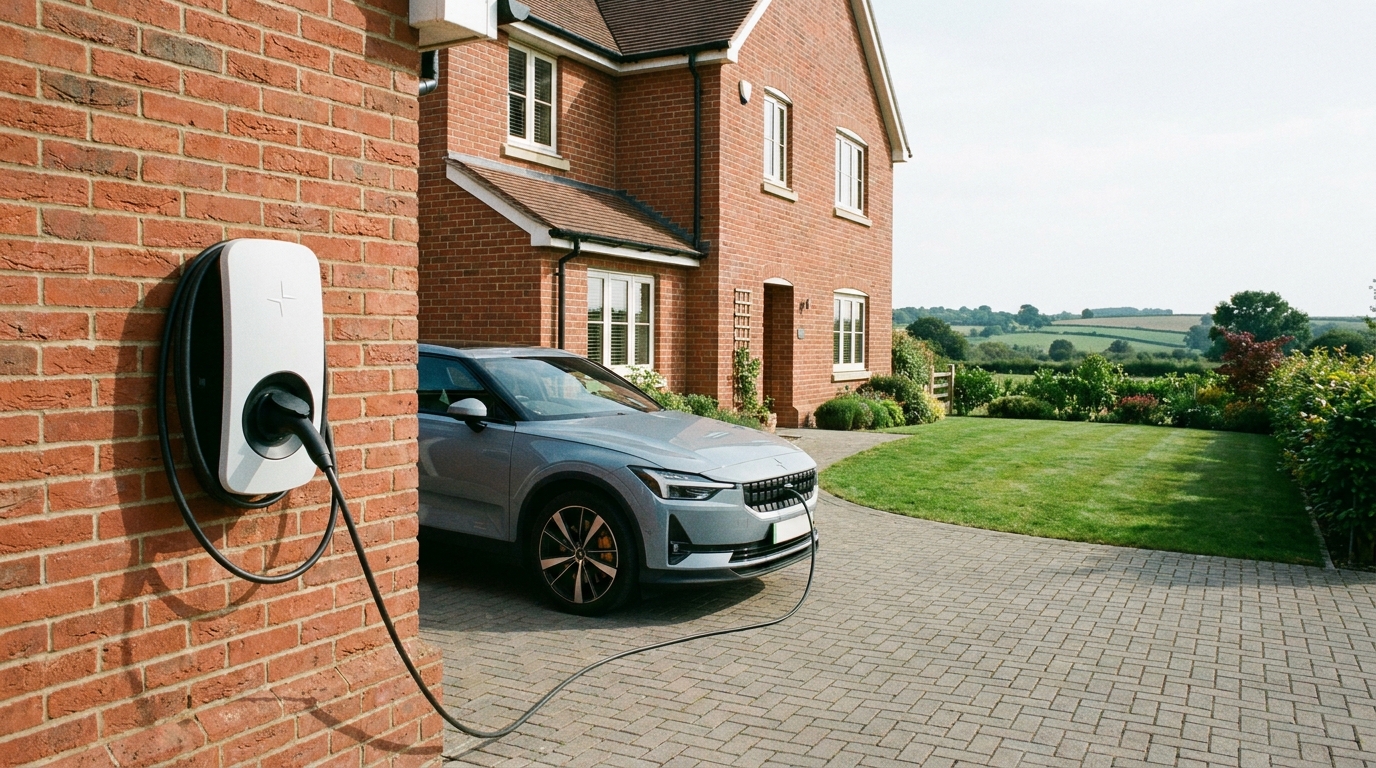
A 7 kW EV wall box mounted on a UK home exterior wall with an electric car charging
Independent UK home EV charging guidance

Straight answers about home EV charging.

No jargon, no sales pitch — just clear, accurate guidance on what an EV charger costs, which type suits your home, the rules that apply, and how to find an OZEV-approved installer. Sourced from OZEV, the IET Wiring Regulations (BS 7671) and GOV.UK.

Free · no obligationSourced from OZEV & GOV.UK
OZEV, IET BS 7671 & GOV.UK sourced Independent — not an installer Free, no-obligation installer quotes

In 30 seconds

Most UK homeowners install a smart 7 kW wall box, fitted by an OZEV-approved electrician on a dedicated radial circuit from the consumer unit — a straightforward half-day job. The £350 OZEV Chargepoint Grant reduces the typical all-in cost to £450–£850 for most standard installations. The charger must be a smart unit (legally required since December 2021), meaning you can schedule charging to cheap overnight tariffs and potentially halve your running costs. Installation is notifiable work under Building Regulations Part P — DIY is not legal and voids the grant. Check the OZEV approved installer list at GOV.UK and get at least three written quotes before committing.

£350
OZEV Chargepoint Grant for eligible drivers
7 kW
standard home charge speed — charges most EVs overnight
3–4 hrs
typical installation time for a standard job
0
obligation — enquiry is always free
The answer library

Every question people actually ask about home EV charging.

Organised the way you think about it — what an EV charger is and how it works, what it costs and how the grant works, the installation rules, your home’s electrical suitability, and how to compare units and find the right installer.

EV charger basics

What an EV charger is, how the different types compare, and why a dedicated 7 kW wall box is the standard for UK homes.

Pillar guide

What is an EV charger?

From a three-pin socket to a dedicated wall box — what the kit does, how it works, and why it matters.

Read the guide →
Basics

What are the different types of EV charger?

Mode 2, Mode 3, AC wall boxes, DC rapids — what each one is and which belongs at home.

Read the guide →
Basics

3 kW vs 7 kW vs 22 kW EV charger: which do you need?

Range per hour, overnight times and what your home supply can actually deliver.

Read the guide →
Basics

Tethered vs untethered EV charger: which is right for you?

One keeps the cable attached; the other gives you a socket. The right answer depends on how you use your car.

Read the guide →

Cost & grants

What installation really costs, how the £350 OZEV grant works and what it costs to charge your car at home day-to-day.

Cost

How much does EV charger installation cost in the UK?

Typical prices, what drives them up or down, and how the £350 OZEV grant affects what you pay.

Read the guide →
Cost

How much does it cost to install a home EV charger?

Breaking down the unit, labour and extras — and what the £350 OZEV grant actually saves you.

Read the guide →
Cost

What is the EV charger grant in the UK?

The £350 OZEV Chargepoint Grant — who qualifies, what it covers and how to make sure it’s applied correctly.

Read the guide →
Cost

How much does it cost to charge an electric car at home?

Per-mile running costs, off-peak tariff savings and how a smart charger cuts your electricity bill.

Read the guide →

Process & rules

Why a qualified electrician is legally required, the planning rules that apply, and how long the installation takes.

Rules

Can I install an EV charger myself?

The short answer is no — and here is why Part P and electrical safety make a qualified installer essential.

Read the guide →
Rules

Do I need planning permission for a home EV charger?

Usually not — most home installations are permitted development, but there are exceptions for flats, listed buildings and conservation areas.

Read the guide →
Rules

What are the EV charger installation requirements in the UK?

Part P, BS 7671, smart regulations and OZEV approval — every rule your installer must follow.

Read the guide →
Rules

How long does it take to install a home EV charger?

Most installations take 3–4 hours on the day — here is what that covers and what can take longer.

Read the guide →

Electrics & reassurance

Whether your home’s supply can handle a charger, what a dedicated circuit means, and how load balancing prevents overload.

Electrics

Do I need a dedicated circuit for a home EV charger?

Yes — and here is why BS 7671 requires its own breaker, cable and RCD protection.

Read the guide →
Electrics

Can I get an EV charger without a driveway?

No off-street parking? Your options in the UK — from charging hubs to on-street charge points and lamp post chargers.

Read the guide →
Electrics

Can my home electrics handle an EV charger?

Most modern UK homes can — here is how to check, and what to do if yours needs an upgrade.

Read the guide →
Electrics

What is EV charger load balancing?

How smart charge points automatically reduce their output when other appliances are running — and why it matters for older homes.

Read the guide →

Comparison & choosing

Comparing charge speeds, smart features and installer criteria — so you can choose the right unit and the right installer.

Compare

How do I choose the best home EV charger for my needs?

What to compare across models — smart features, solar integration, load management and the right speed for your home.

Read the guide →
Compare

7 kW vs 22 kW home EV charger: which should you choose?

Three-phase, car limits and whether 22 kW is actually worth it for a UK home.

Read the guide →
Compare

Smart vs standard EV charger: what is the difference?

Smart chargers are now legally required for new UK home installs — here is what that means and what you actually get.

Read the guide →
Compare

How do I choose an EV charger installer?

What OZEV approval means, what a good quote includes, and the red flags to watch for.

Read the guide →
Compare

How do I get EV charger quotes and what should I compare?

What to expect when you enquire, how quotes work, and what a fair price looks like after the £350 OZEV grant.

Read the guide →
How it works

From first question to working charger, in three steps.

You do not need to know which charger you want before you enquire. An OZEV-approved installer can assess your home and recommend the right unit.

  1. Tell us about your home. A short, no-obligation enquiry — your parking setup, where the consumer unit is and what car you drive. No technical knowledge needed.
  2. Get quotes from approved installers. We connect you with OZEV-approved installers who assess your property, confirm grant eligibility and provide written supply-and-fit quotes.
  3. Get installed and start charging. Your chosen installer fits the smart wall box in a single visit, issues the Electrical Installation Certificate and sets up your charging app.

Ready to get a home EV charger?

Compare quotes from OZEV-approved installers and get the £350 grant applied automatically. It’s free to enquire, there’s no obligation, and a qualified installer can assess exactly what your home needs.

Free to use. No obligation. We are an independent guide, not an installer.