The short answer
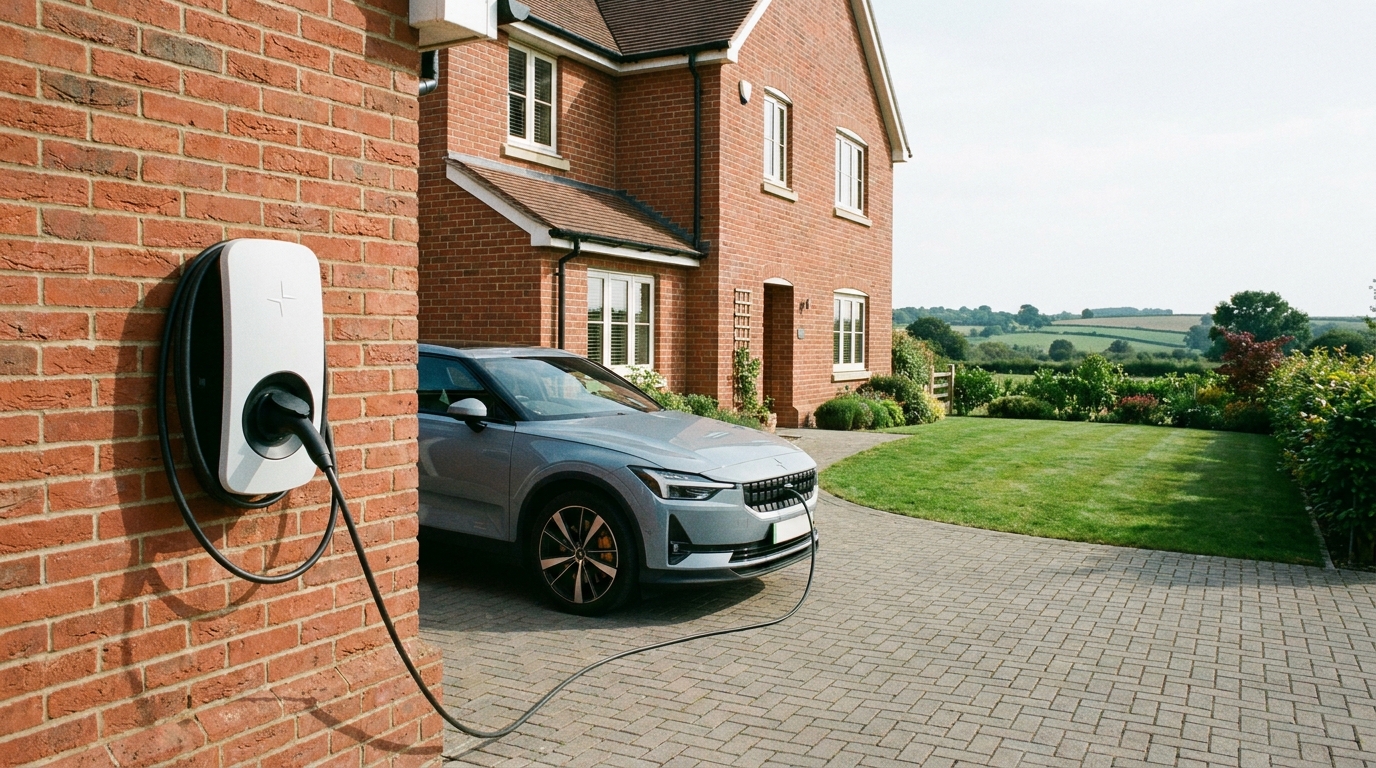
An EV charger is a device that converts mains electricity into the form your electric car’s battery needs, controlling the rate of charge safely. A dedicated home wall box charges far faster and more safely than a three-pin plug. Most households install a 7 kW unit, which can top up a typical EV overnight. Installation must be carried out by a qualified electrician under Building Regulations Part P.
Most drivers first encounter EV charging through the three-pin socket in their garage — familiar, but slow and not designed for continuous overnight use. A dedicated home charge point changes that: it communicates with the car, manages the charge rate safely, and can fully replenish most batteries overnight. Understanding what the hardware actually does — and why the installation rules exist — makes every subsequent decision about type, cost and installer much easier to navigate.
EV charger basics at a glance
- Home charge speed Typically 7 kW — around 25–30 miles of range per hour
- Three-pin plug speed Around 2.3 kW — slow and not recommended for regular use
- Installation Must use a qualified electrician under Part P / BS 7671
- OZEV grant £350 towards a home charger for eligible drivers (see grant guide)
- Smart chargers Required on all new installations since December 2021
- Typical install time 3–4 hours for a straightforward installation
How an EV charger works
An electric vehicle charger — often called a charge point or wall box — draws alternating current (AC) from your home mains supply and delivers it to the car via a standardised connector. The car’s on-board charger then converts that AC power into the direct current (DC) the battery stores. The charge point itself manages the communication between car and mains: it checks the car’s state of charge, respects any charge limits you have set, and cuts power safely if it detects a fault. That control circuit is one of the main reasons a dedicated unit is safer than an ordinary socket — a three-pin plug has no such dialogue with the vehicle and can overheat under sustained high current draw.
Charge points installed at home are almost universally AC units. Rapid DC chargers — the type you find at motorway service stations — bypass the car’s on-board converter and push power directly into the battery at far higher rates, but they require specialist three-phase supplies and cost tens of thousands of pounds to install, making them impractical for domestic use. For the vast majority of drivers, 7 kW AC at home covers all everyday charging needs.
The difference between a wall box and a three-pin plug
The Office for Zero Emission Vehicles (OZEV) and the Energy Saving Trust both advise against using a standard three-pin socket as a primary EV charging method. The reasons are practical as well as electrical:
| Feature | Three-pin plug | Dedicated wall box |
|---|---|---|
| Typical power | 2.3 kW (10 A) | 7 kW (32 A) |
| Range added per hour | ~8 miles | ~25–30 miles |
| Safety controls | None EV-specific | Dynamic load management, fault detection, auto cut-off |
| Smart scheduling | No | Yes (off-peak tariff timing) |
| Installation required | No | Yes — qualified electrician, Part P |
Three-pin charging is useful in an emergency or at a destination without a charge point, but the sustained current draw on a domestic socket ring circuit — often overnight for hours — creates heat in connectors not designed for it. A dedicated radial circuit from the consumer unit, wired by a qualified electrician to IET Wiring Regulations (BS 7671), is the correct solution.
What “smart” means
Since December 2021, the UK government requires all new home charge points to be “smart” — capable of receiving and acting on signals to shift charging to times when electricity is cheaper or the grid is less stressed. In practice this means a charge point that connects to your home Wi-Fi, can be scheduled via an app, and can take advantage of cheaper off-peak tariffs designed for EV drivers (such as Octopus Go or British Gas EV tariffs). Smart charging does not mean the car charges itself unsupervised — it means the timing is optimised. See our guide on smart vs standard chargers for the full picture.
Connectors and compatibility
Most new electric cars sold in the UK use a Type 2 (Mennekes) socket for AC charging. The charge point’s cable connects to this. Charge points come in two forms: tethered units (cable permanently attached) or untethered (socket only, you use your own cable). Older plug-in hybrids and some early EVs used Type 1 connectors, but these are increasingly rare for new purchases. Check your car’s manual or specification sheet to confirm the AC charging connector before choosing a unit — the installer will also verify this.
Do I need planning permission?
In most cases, no. Installing a home charge point is permitted development under the General Permitted Development Order in England, provided the unit is no larger than 0.2 cubic metres in volume and is installed on a property with a car parking space. There are exceptions for listed buildings and some flats. See the full guide on planning permission for EV chargers for the detail. The installation itself must comply with Building Regulations Part P (electrical safety in dwellings) and the IET Wiring Regulations BS 7671, which is why a qualified electrician is legally required for the work.
Can I install a charge point myself?
No — and this is an important point. Installing a home EV charge point involves running a new radial circuit from the consumer unit, which is notifiable electrical work under Building Regulations Part P. Only a qualified electrician who is registered with a competent person scheme (such as NICEIC or NAPIT) or who obtains a building control certificate can legally carry out this work. See our full guide on whether you can install it yourself. Beyond the legal requirement, incorrect wiring of a charge circuit creates genuine fire and electric shock risk. Always use a qualified, OZEV-approved installer.
This page provides general information about how EV charge points work and the installation rules that apply. It is not electrical or installation advice for your specific property; always consult a qualified, OZEV-approved installer who can assess your home’s electrical supply before any work begins.
Frequently asked questions
What does an EV charger do?
It converts mains AC electricity into the form your electric car’s battery needs, controlling the charge rate safely and communicating with the vehicle. A dedicated wall box is faster and safer than a three-pin socket.
How fast does a home EV charger charge?
A typical 7 kW home wall box adds around 25–30 miles of range per hour. A full charge from near-empty on most EVs takes 6–12 hours overnight, depending on the car’s battery size.
Do I need a smart EV charger?
Yes, for all new home installations in Great Britain since December 2021. Smart charge points can schedule charging to off-peak tariffs and respond to grid signals, saving money and supporting the electricity network.
Who can install a home EV charger?
Only a qualified electrician — the work is notifiable under Building Regulations Part P. Using an OZEV-approved installer is also a condition of the government’s £350 EV charger grant.
Sources & further reading
- OZEV (Office for Zero Emission Vehicles) — EV chargepoint grant guidance and installer approval scheme
- Energy Saving Trust — Home EV charging advice and smart charging guidance for UK drivers
- IET Wiring Regulations (BS 7671) — UK standard for electrical installations including EV charge circuits
- GOV.UK — Electric Vehicles (Smart Charge Points) Regulations 2021 and Building Regulations Part P
This is general information about home EV charging in the UK, not electrical, planning or installation advice for your specific property. Costs, timescales and specifications vary with your home’s supply, parking arrangement and chosen installer. Always obtain written quotes from OZEV-approved installers and check grant eligibility at GOV.UK before committing.