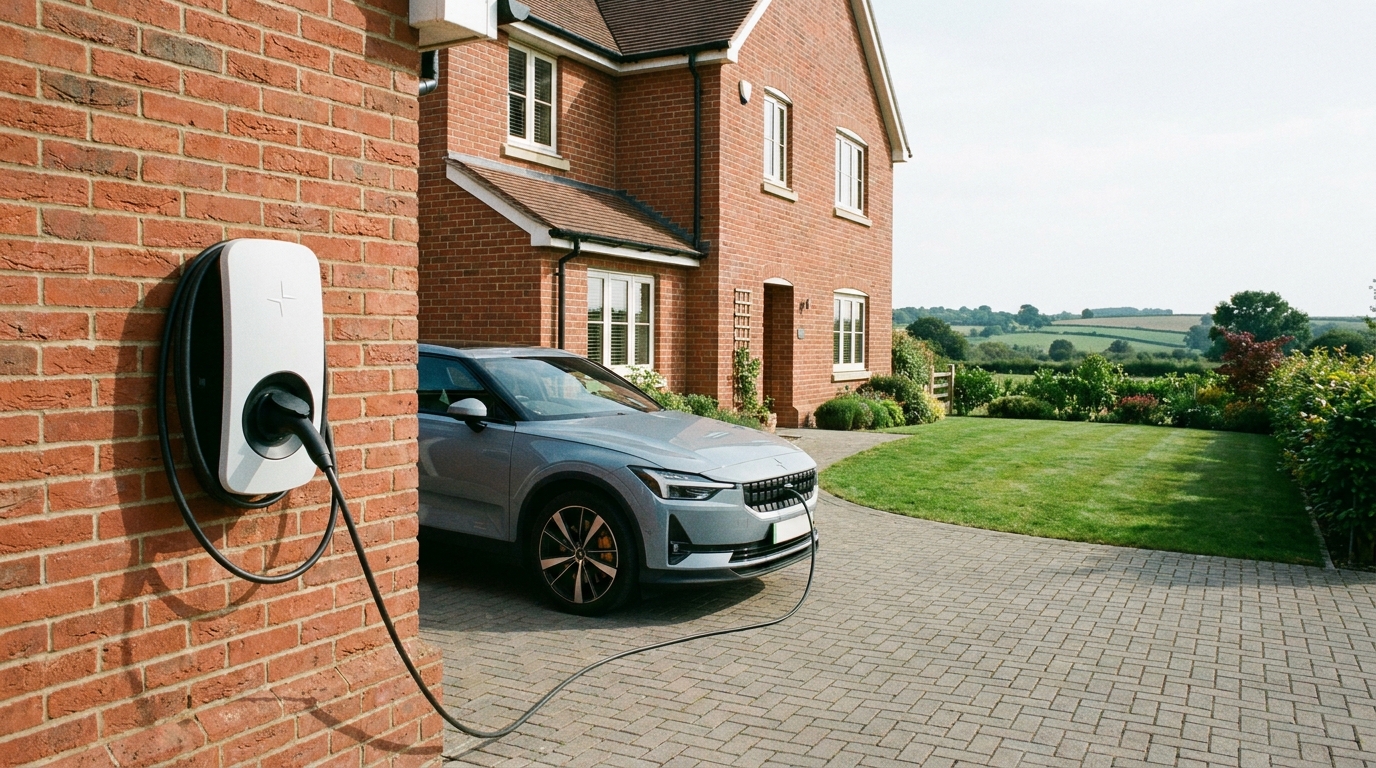
The short answer
In most cases, no. Installing a home EV charge point is permitted development in England, meaning planning permission is not required — provided the unit is not larger than 0.2 cubic metres and the property has off-street parking. Exceptions apply for listed buildings and some flats. You still need the installation certified under Building Regulations Part P, which is a separate requirement from planning.
Planning permission and building regulations are two different things, and it is easy to confuse them. Planning permission governs what you build and where; building regulations govern how it is built safely. For a home EV charger, you almost certainly do not need planning permission (it falls under permitted development rights), but you definitely do need the electrical installation certified under building regulations. This guide focuses on the planning question; see the linked guides for the building regulations side.
Planning permission for EV chargers at a glance
- England (most homes) Permitted development — no planning permission needed
- Scotland Permitted development — check Scottish planning guidance
- Wales Permitted development — check TAN guidance
- Listed buildings May require listed building consent
- Flats / apartments Check your lease and permitted development conditions
- Volume limit Unit must be no larger than 0.2 cubic metres
Permitted development rights in England
In England, the installation of an EV charge point at a house or flat falls within permitted development rights under the Town and Country Planning (General Permitted Development) (England) Order 2015, as amended. Permitted development means the work is automatically approved, without you needing to make a planning application, provided certain conditions are met. The conditions for EV charge points include:
- The unit must not exceed 0.2 cubic metres in volume.
- The property must have a dedicated parking space or garage — the charge point should serve that space.
- Only one charge point per dwelling is permitted without consent.
- The charge point must not be installed on a highway.
Almost every domestic wall box meets these conditions comfortably — a standard 7 kW unit is far smaller than 0.2 m³. If your property has off-street parking and a standard house structure, you can proceed without a planning application.
| Property type | Typical planning position | Action required |
|---|---|---|
| Detached, semi, terrace (England) | Permitted development | None — just install and certify electrically |
| Listed building | May need listed building consent | Contact local planning authority |
| Conservation area property | Usually permitted development, but check | Confirm with local planning authority |
| Flat / apartment | Check lease and permitted development conditions | Check lease; may need freeholder consent |
Listed buildings and conservation areas
If your home is a listed building, any alteration to the building — including attaching a charge point to an external wall — may require listed building consent, separate from and additional to planning permission. This is a straightforward application to your local planning authority. Conservation area properties are generally still covered by permitted development for EV chargers, but if in any doubt, a pre-application enquiry to the planning authority takes only days and gives you certainty. Do not rely on a general answer from an installer about listed buildings — they are not planning advisers.
Scotland and Wales
Scotland and Wales have their own planning frameworks. In Scotland, EV chargers at domestic properties generally fall within permitted development under the Town and Country Planning (General Permitted Development) (Scotland) Order 1992, with similar volume and parking conditions. In Wales, Technical Advice Notes and the development management framework apply; the position is broadly similar but always worth confirming with your local planning authority if you have any doubt about your specific property.
Building regulations are always required
Regardless of the planning position, the electrical installation of any dedicated EV charge point must comply with Building Regulations Part P and the IET Wiring Regulations (BS 7671). This is not optional — it applies even if planning permission is not needed. See can I install an EV charger myself for a full explanation of the legal installation requirements. An OZEV-approved installer handles both the electrical certification and helps you confirm the planning position for your property. This page is general information about planning rules; it is not planning or legal advice for your specific circumstances.
Frequently asked questions
Do I need planning permission for a home EV charger in England?
Almost certainly not. Most home EV charger installations are permitted development in England, meaning no planning application is needed, provided the unit is under 0.2 m³ and the property has off-street parking.
Do I need consent for an EV charger on a listed building?
Possibly — attaching a charge point to a listed building may require listed building consent. Contact your local planning authority before proceeding.
Can I install an EV charger in a flat?
Potentially, but check your lease for freeholder consent requirements and confirm your property has a dedicated parking space. Permitted development conditions vary for flats.
Is planning permission different from building regulations for an EV charger?
Yes, they are entirely separate. Planning permission covers what is built; building regulations cover how it is built safely. You may not need the first but you always need the second (Part P and BS 7671).
Sources & further reading
- GOV.UK — Town and Country Planning (General Permitted Development) Order — EV charge point provisions
- GOV.UK — Building Regulations Part P: electrical safety in dwellings
- OZEV (Office for Zero Emission Vehicles) — Chargepoint grant and installation guidance
- Energy Saving Trust — Home EV charging installation and planning guidance for UK homeowners
This is general information about home EV charging in the UK, not electrical, planning or installation advice for your specific property. Costs, timescales and specifications vary with your home’s supply, parking arrangement and chosen installer. Always obtain written quotes from OZEV-approved installers and check grant eligibility at GOV.UK before committing.