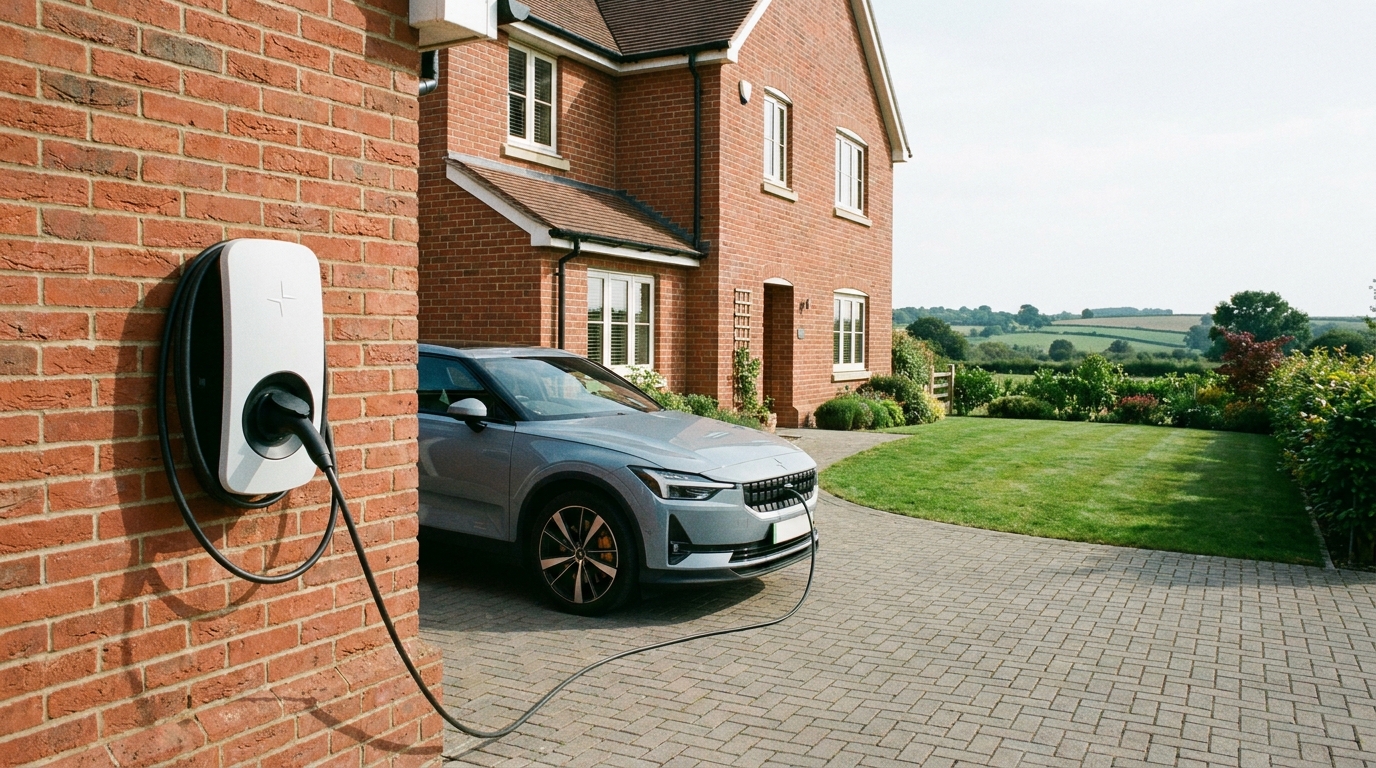
The short answer
A smart EV charger can be scheduled, monitored remotely and can shift charging to off-peak hours; a standard (dumb) charger starts charging immediately on plug-in with no scheduling. Since December 2021, all new home installations in Great Britain must use a smart unit. Smart scheduling is also the main way to cut your home charging cost by using cheap overnight tariffs.
The terms “smart charger” and “dumb charger” are widely used but not always clearly explained. Since December 2021, the distinction is not just a feature choice — it is a legal requirement for new UK home installations. This guide explains what smart capabilities mean in practice, what you actually benefit from, and whether the older standard units still have any relevance.
Smart vs standard charger at a glance
- Standard (dumb) charger Charges immediately on plug-in, no scheduling
- Smart charger Schedulable via app, internet-connected, responsive to grid
- Legal status Smart required for all new UK home installs since Dec 2021
- Off-peak scheduling Smart only — key to cutting charging costs
- Solar integration Available on some smart models (e.g. Zappi)
- App control Yes on smart units — set schedule, view history, override
What a standard (dumb) charger does
A standard charge point has no internet connection and no scheduling capability. When you plug in your car, charging starts immediately at the rated power and continues until the car is full or you unplug. For drivers on a flat-rate electricity tariff this is straightforward, but it means you cannot automatically take advantage of cheaper off-peak rates or shift your charging away from peak grid demand times. Standard units are no longer legal for new domestic installations in Great Britain.
What a smart charger adds
A smart charge point connects to your home Wi-Fi and communicates with a back-end system (the manufacturer’s servers or a local controller). The core capabilities required by the Electric Vehicles (Smart Charge Points) Regulations 2021 include:
- Scheduling: you can set the charger to start and stop at specific times via a smartphone app. Set it to charge between midnight and 6 am on an off-peak tariff and it runs automatically every night.
- Demand-side response: the charger can receive signals to delay or pause charging during periods of grid stress, supporting the electricity network.
- Remote access: start, stop or adjust charging from your phone without physically going to the charge point.
- Consumption data: view your charging history, energy used and estimated cost over time.
| Feature | Standard charger | Smart charger |
|---|---|---|
| Automatic scheduling | No | Yes — via app |
| Off-peak tariff automation | No | Yes |
| Remote monitoring | No | Yes |
| Solar PV integration | No | Some models (e.g. Zappi) |
| Demand-side response | No | Yes — required by regulations |
| Legal for new UK install | No (since Dec 2021) | Yes |
Solar PV integration: the next level
Some smart chargers go beyond scheduling and can integrate with a home solar PV system. Myenergi’s Zappi is the best-known UK example: it detects surplus solar generation (power that would otherwise be exported to the grid for a low export tariff) and diverts it into the car first. In “ECO” or “ECO+” mode, the Zappi varies its charge rate dynamically from 1.4 kW to 7 kW to match available surplus. If you have or are planning solar PV, a solar-integrated smart charger can reduce your grid electricity use for charging to near zero on sunny days. See how to compare charger models for where solar-integration units fit in the broader choice. This page is general information about smart charger features; the right unit depends on your specific installation, tariff and priorities — always discuss with an OZEV-approved installer.
Frequently asked questions
Can I still buy a standard (non-smart) EV charger?
Not for a new home installation in Great Britain. The Electric Vehicles (Smart Charge Points) Regulations 2021 require all new home charge points to be smart-capable. Replacement of a like-for-like existing unit may have different rules — check with your installer.
Do I have to use the smart features on my charger?
No — you can simply plug in and charge if you prefer. But using the scheduling features to charge at off-peak tariff rates is the main financial benefit of a smart charger.
Is a smart EV charger more expensive than a standard one?
New domestic units are all smart, so the comparison is not relevant for new installs. Among smart units, entry-level models with basic scheduling start from £300, while premium solar-integration units run to £700+.
Can my smart charger take advantage of a cheap overnight EV tariff?
Yes. Set a schedule in the app to match your tariff’s cheap window (e.g. midnight to 5 am) and the charger will start and stop automatically, leaving the car ready in the morning.
Sources & further reading
- GOV.UK — Electric Vehicles (Smart Charge Points) Regulations 2021 — requirements and enforcement
- OZEV (Office for Zero Emission Vehicles) — Smart charging mandate and approved installer scheme
- Energy Saving Trust — Smart home EV charging, off-peak tariffs and solar integration guidance
- IET Wiring Regulations (BS 7671) — Smart charge point installation and commissioning requirements
This is general information about home EV charging in the UK, not electrical, planning or installation advice for your specific property. Costs, timescales and specifications vary with your home’s supply, parking arrangement and chosen installer. Always obtain written quotes from OZEV-approved installers and check grant eligibility at GOV.UK before committing.